
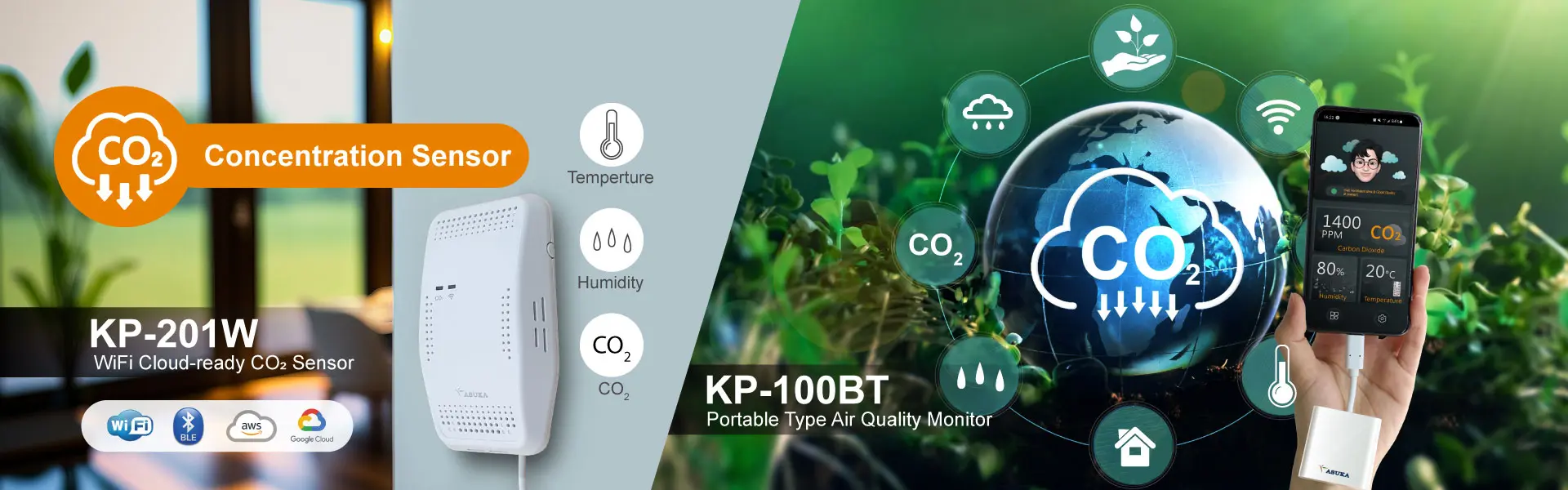
Products

KP-200W Wi-Fi MQTT Cloud Ready Environmental IoT Sensor
- Equipped with Infineon's PAS CO2 and ASUKA's sophisticated hw/sw design for cloud-based data service.
- Perform accurate CO2 concentration measurements and upload the results to the cloud every 10 seconds.
- A built-in relay to control peripheral devices such as fans or warning lights.
- A dashboard shows CO2/ Temp/ Humidity measurements with historical analysis for your immediate service.
- Ideal solution for smart building, smart agriculture, and industrial environment monitoring applications.
Start by creating a fresh indoor air quality
Protect the health of your employees and customers and meet the requirements of the Environmental Protection Administration's Indoor Air Quality Act.
Indoor air quality primarily focuses on carbon dioxide. The concentration should not exceed 1,000 ppm.
Carbon dioxide (CO2), colorless and odorless, is a waste gas exhaled by humans. Its generation is determined by the number of people and the air conditioning capacity, and it is the most critical indicator of indoor air quality.
The CO2 concentration of fresh outdoor air is usually 400 ppm, while the CO2 concentration of a well-air-conditioned office is around 600-800 ppm. Numerous studies have confirmed that when the CO2 concentration in indoor air reaches 1,000-1,500 ppm, people will start to feel uncomfortable; when it reaches 3,000-4,000 ppm, most people will experience headaches, tinnitus, and increased blood pressure.
If a person lives or works in an environment with high CO2 concentration for a long time, it will inhibit the respiratory center and easily cause brain fatigue, drowsiness, and lethargy; office workers will feel overwhelmed, and students' learning will be greatly affected, seriously impacting people's lives.
Product Features
The effects of carbon dioxide on human health.